DIY vs Professional Ant Control in Boise, ID
Ants you are actually likely to see in the Treasure Valley
Identification comes first, because bait, nest location and whether DIY is even a good idea all depend on the species. For a fuller identification guide, start at ant control in Boise. The comparison on this page is about when to treat it yourself and when to hire help.
A University of Idaho Extension publication on nuisance ants (CIS 988, Homan and Merickel) states that the odorous house ant is the most common ant in Idaho homes, with the pavement ant next. Other ants found in houses, according to that publication, include Lasius ants, little black ants and thatch ants. It also notes that harvester ants are occasionally found in homes on the Snake River plains — the region that includes the Treasure Valley. They can sting and usually nest in open, sunny soil, so they are less often a kitchen-trail pest than a yard pest.
Pacific Northwest Extension publication PNW 624, written for Washington, Idaho and Oregon, describes the key structural ant pests in the region, including odorous house ants, pavement ants, carpenter ants, harvester ants and thatching ants. Thatching or mound ants (Formica), sometimes called field ants, belong in that regional key; they typically nest in lawns and landscape beds rather than in kitchen wall voids. Carpenter ants are the wood-nesting exception: large black or red-and-black ants that tunnel in damp wood and can damage a structure over time.
Fire ants, which show up in some national pricing tables, are not treated here as a Treasure Valley house pest. If you are unsure of the species, a close photo or a specimen is more useful than a guess from the neighborhood.
Bait vs spray: why the trail you can see is not the colony
The ants on a kitchen counter are foraging workers. The queen or queens, the brood and most of the colony stay in the nest — often in soil along a foundation or sidewalk, under a slab, or, for carpenter ants, in damp wood. University of Idaho Extension notes that workers may forage a long way from the nest, and that locating the colony is the starting point for control.
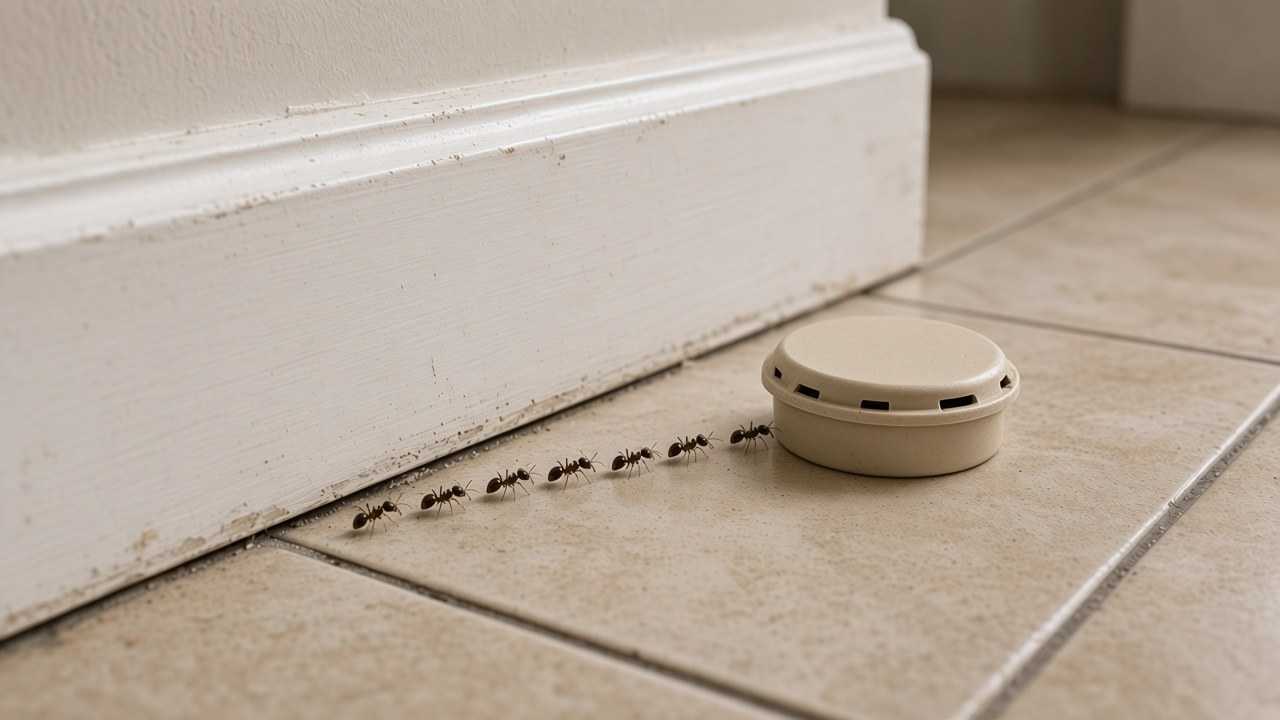
Slow-acting baits work when workers take the bait back and share it. That is why you place bait on the active trail, match sweet or protein baits to what the ants are taking, and avoid spraying or heavy cleaning on that trail while the bait is working. More ants at the station for a day or two can be a good sign. Activity should drop over several days to a couple of weeks.
Repellent sprays often backfire. They kill the workers you can see, and survivors may avoid the treated area, split the colony, or open new trails. That budding behavior is a particular problem with odorous house ants and pavement ants. Save sprays for a wasp nest or a similar situation; they are a poor first tool for a trailing kitchen ant. Keep all products away from children and pets, and follow the label.
Why bait can reach a colony, and when to call a pro
- Place slow-acting bait on the active trail, not where you wish the ants would go
- Workers can carry bait back to a nest in soil, under a slab or along the foundation
- Repellent sprays kill visible foragers and can split a colony or block baiting
- Call a pro for carpenter ants, hidden nests, or trails that continue after correct baiting
University of Idaho Extension emphasizes reaching the colony, not only the ants you can see. Keep baits away from children and pets, and follow the label.
Kitchen trails have their own details — sinks, dishwashers and pet bowls — in the guide to ants in the kitchen in Boise.
When DIY is enough, and when to call a pro
DIY is a reasonable first step when the trail is new, it is limited to one room or entry, you can see where ants are coming in, there is no sawdust-like frass or damaged wood, and you can keep children and pets away from bait. Fix the leak, wipe up the spill, and seal the gap as part of the same effort. Outdoor mounds well away from the house can sometimes be treated as a yard issue, but harvester-ant mounds should be left alone if you are not prepared for stings.
Call a licensed provider when any of these are true:
- Trails continue or spread after two to three weeks of correct baiting.
- Ants are coming from wall voids, under a slab, or from several sides of the house at once.
- You see large black ants indoors, especially in winter or spring, or piles of sawdust-like frass — see carpenter ant control.
- Winged swarmers appear indoors. Rule out termites with the termite inspection comparison before you treat.
Pest control in Idaho is regulated by the Idaho State Department of Agriculture. A licensed applicator can use products and placements that are not available at retail, and can inspect for nests in crawlspaces, eaves and damp wood that a homeowner may not reach safely.
Cost comparison, with sources
Local ant prices are not invented here, and a Boise company page that publishes a standalone “ant exterminator” menu with a single fixed number was not found. The figures below are the published national ranges, plus local general-pest visit prices that may or may not include ants — always ask.
- Angi’s ant exterminator cost article (updated September 23, 2026) lists a U.S. average of $250 per visit, with most homeowners paying $200 to $300 for a standard treatment. The same article lists DIY costs of $30 to $100 (baits $10 to $40, sprays $10 to $30, traps $10 to $20) and professional service at $80 to $500 or more. Method averages include baiting at $120 to $200 and barrier treatment at $80 to $150. Specialty treatment for wood-damaging ants is listed at $250 to $500. Quarterly contracts are listed at $400 to $500 per year in that article’s frequency table.
- HomeAdvisor’s ant exterminator cost page lists a typical range of $80 to $500, with an average around $150 for a single treatment, and about $100 to $120 per additional visit if more than one trip is needed.
- This Old House lists common DIY products at about $10 to $30 per item, including granule baits at $10 to $20 and gel baits or bait stations at $20 to $30.
- Local general-pest examples, which are not ant-only quotes: Green Guard lists a one-time visit at $200 (up to 2,500 square feet); Wild West lists $199 per standalone treatment; American Exterminator offers a separate ant baiting service and states that ants are not included in its one-time general service. For plan-level pricing, see one-time vs quarterly vs monthly plans and the cost guide.
A few retail bait stations are much cheaper than a professional visit. That math holds only if the bait actually reaches the colony. Repeated sprays, the wrong bait, or a missed carpenter-ant nest can cost more in time — and, in the carpenter-ant case, in wood damage — than hiring help once.
Species identification, bait placement and yard conditions are covered in more detail on ant control in Boise. Kitchen trails have their own page, ants in the kitchen, and large wood-nesting ants belong on carpenter ant control. For one-time versus recurring plan prices, see pest control plans and the cost guide.
A practical sequence for a Boise ant trail
- 1Inspect
Find the trail, the entry gap, and any food or moisture source. Note whether the ants are small trail-builders or large wood-nesting ants, and whether frass is present.
- 2Identify
Compare them with odorous house ants, pavement ants and carpenter ants. Crushing one odorous house ant produces a rotten-coconut smell; pavement ants often nest under sidewalks; large ants plus frass point to carpenter ants.
- 3Treat
For a short trailing-ant problem, place slow-acting bait on the trail, remove competing food, and do not spray the path. If bait fails, the nest is hidden, or carpenter ants are likely, request a licensed inspection.
- 4Prevent
Pull mulch back from the foundation, fix irrigation that soaks the slab, seal utility gaps, and store sweets and pet food in sealed containers so a new colony is not invited back.
Sources
- University of Idaho Extension, CIS 988, Nuisance Ants (H. W. Homan and F. W. Merickel)
- Pacific Northwest Extension, PNW 624, Identification and Habits of Key Ant Pests in the Pacific Northwest
- Angi, How Much Does an Ant Exterminator Cost? [2026 Data], updated September 23, 2026
- HomeAdvisor, How Much Does an Ant Exterminator Cost?
- This Old House, How Much Does an Ant Exterminator Cost? (2026)
- Green Guard Pest Control, Pricing; Wild West Pest Control, 2026 pricing guide; American Exterminator
Frequently asked questions
Can I get rid of ants in my Boise kitchen myself?+
Often, if the trail is new, limited to one area, and you can also clean up food and moisture. University of Idaho Extension guidance for Idaho homes emphasizes finding the colony when you can and using a method that reaches it, not just killing the ants you see. Slow-acting baits on the trail, with competing food removed, are the usual DIY starting point. If trails continue after a couple of weeks of correct baiting, or ants are coming from walls or damp wood, it is time for a licensed provider.
Should I spray ants or use bait?+
For most trailing ants, bait is the better first move. Workers need to carry a slow-acting bait back and share it in the nest. Repellent sprays kill the foragers you can see and can cause survivors to split the colony or route around the treated area, which is a known problem with odorous house ants and pavement ants. Carpenter ants are different: they usually need the nest found and treated directly, which is hard to do from a retail spray can.
How much does a professional ant exterminator cost?+
Angi’s September 2026 ant-exterminator article lists a U.S. average of $250 per visit, with most homeowners paying $200 to $300 for a standard treatment, and a DIY range of $30 to $100 versus $80 to $500 or more for professional service. HomeAdvisor lists a typical single-treatment range of $80 to $500 with an average around $150. This Old House lists common DIY bait products at about $10 to $30 per item. A Boise-only published ant menu, separate from general pest visits, was not found; local one-time general visits published by Green Guard ($200) and Wild West ($199 standalone) often include ants on a general plan, but American Exterminator states that ants are not included in its one-time general service.
What kinds of ants are common in the Treasure Valley?+
University of Idaho Extension (CIS 988) says the odorous house ant is the most common ant in Idaho homes, with the pavement ant next. The same publication notes thatch ants, Lasius ants and little black ants in houses, and that harvester ants are occasionally found in homes on the Snake River plains, which includes the Treasure Valley. Pacific Northwest Extension publication PNW 624 covers those structural pests, plus carpenter ants, for Idaho, Washington and Oregon. Have a specimen identified when you can; bait choice depends on the species.
When should I stop DIY ant control and call a pro in Boise?+
Call a licensed provider if trails return after two to three weeks of correct baiting, if ants are coming from wall voids or under a slab, if you see large black ants indoors or sawdust-like frass (possible carpenter ants), or if winged swarmers appear indoors and you need to rule out termites. Pest control in Idaho is regulated by the Idaho State Department of Agriculture, and a licensed applicator can use products and placements that are not sold at retail.
Licensing in Idaho: how to verify a provider
In Idaho, professional pesticide applicators are licensed by the Idaho State Department of Agriculture (ISDA). To get licensed, they pass an exam for each category of work they do and show proof of financial responsibility. Since ISDA's 2024 rule update, home and building pest work for insects, spiders and wood-destroying pests such as termites falls under the Industrial, Institutional, and Structural Pest Control – Non-Commodity (IP) category. Rodent work may also involve General Vertebrate Control (GV). (ISDA license categories)
Before you hire anyone, ask for the applicator's name and license number. Check that the license is current, and that it covers the right category, with ISDA's Certified Applicator License Search, or call ISDA pesticide licensing at (208) 332-8600. Also ask what products they plan to use, and ask for the label or safety data sheet if you have kids, pets, or a well.