Spider Mite Control in Boise, ID: Plants, Not House Spiders
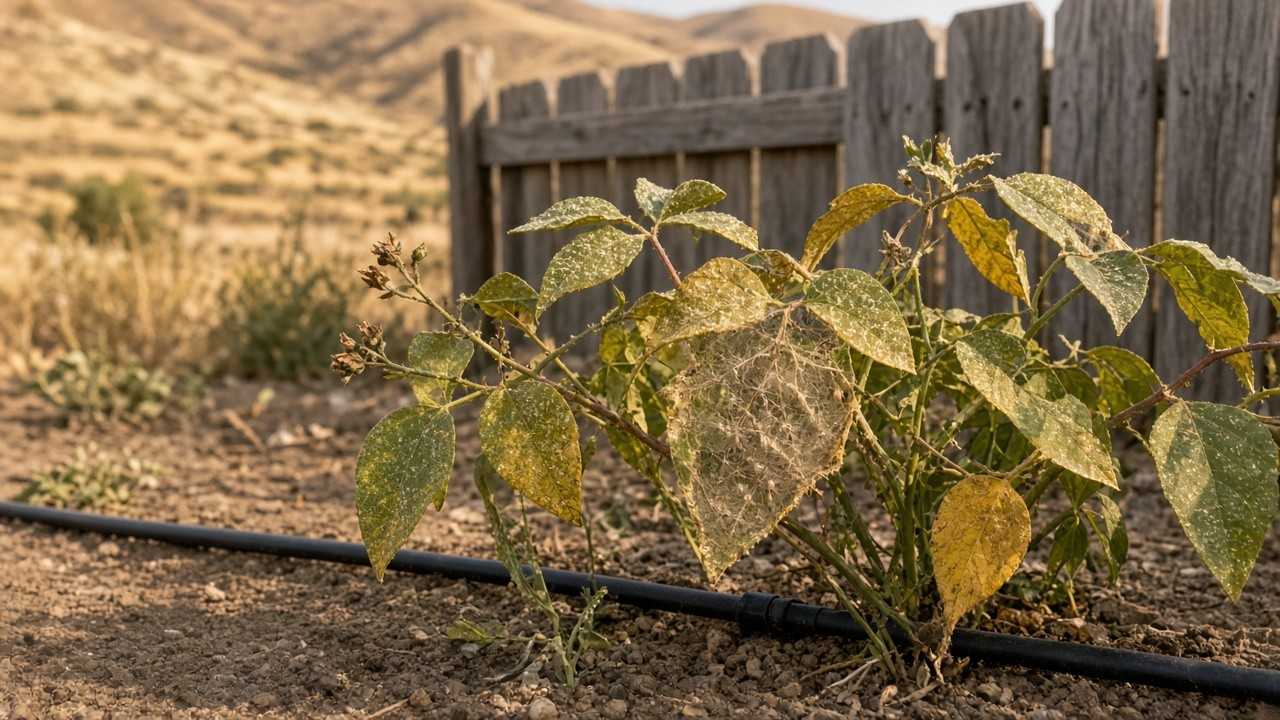
Pest ID: Two-spotted spider mites (Tetranychus urticae)
Danger level: LowHow to recognize it
- Adults are about 1/50 inch (0.5 mm) long and usually need a hand lens to see
- Often light yellow or translucent, with two dark side patches that can merge or be missing; they may look brown or red late in the season
- Adults and nymphs have eight legs; the six-legged larval stage is smaller
- Fine silk webbing on leaf undersides, mid-veins or branch axils when numbers are high
- Leaf stippling that starts pale and can turn red or bronze; severe cases can defoliate a plant
Where it shows up
- Undersides of older, already stippled leaves on garden and landscape plants
- Roses, beans, tomatoes, cucurbits, evergreens, maples and many other hosts — University of Idaho calls them extreme generalists
- Dusty, drought-stressed plantings and field or fence-line edges
- Not typically in garage corners or window-well spider webs
Common look-alikes
- House spiders
- House spiders are visible without a lens and build webs or hunt in structures. They do not stipple leaves. See spider control in Boise if the issue is indoor or garage webs.
- Dust, sun scorch or nutrient deficiency
- Those can discolor leaves, but they do not produce moving specks on white paper or fine silk nests on the underside. Confirm mites before you treat.
- Clover mites
- Clover mites walk onto sunny windowsills and south-facing walls from the lawn in cool weather. They do not stipple garden leaves or spin fine webbing on plants. See clover mite control if the specks are on a sill, not on a leaf.
- Predatory mites
- Beneficial mites also move on leaves and help keep pest mites down. The Pacific Northwest handbook notes it is worth telling pest and predator mites apart before you spray.
Why the danger rating: These mites damage plants, not people. They are a garden and landscape pest, not a medically important house spider.
These are plant pests, not house spiders
The name causes the mix-up. Spider mites make silk, and they are arachnids, but they feed on plant sap. They are not a house-spider problem, and a perimeter spider treatment will not fix stippled tomatoes or roses. If you came here from a spider search, you can return to the spider guide for webs in garages, eaves and window wells, or use this page if the damage is on a plant. Tiny reddish specks walking on a sunny windowsill, rather than on a leaf, are usually clover mites from the lawn.
University of Idaho Extension’s two-spotted spider mite guide (Wickwar and Wenninger, 2023) describes Tetranychus urticae as an extreme generalist on hundreds of hosts, including garden vegetables, roses, evergreens and shade trees. Adults are usually about 1/50 inch long. The Pacific Northwest landscape spider mite handbook adds that several mite species can damage ornamental plants in the region, and that hot, dry conditions tend to increase numbers.
How to confirm mites on a Treasure Valley plant
Look first at the leaves. Extension describes stippling from piercing-sucking feeding, then a red or bronze cast as damage continues, and visible webbing when an infestation is heavy. Turn older, already damaged leaves over. A hand lens helps. You can also hold white paper under a branch and tap it; moving dust-like specks are mites.
Scout more often in hot, dry weather, in dusty spots, and after a broad-spectrum insecticide was used for some other insect. University of Idaho Extension notes that pyrethroids and organophosphates can kill natural predators and then allow mite outbreaks. There is usually no economic threshold published for mites on backyard plants; the same guide says to consider treatment when an infestation is evident and hot, dry weather is likely to keep it growing, and that treatment has to happen before damage becomes severe.
Read a leaf before you treat for spider mites
- Pale stippling on the leaf, which can later turn red or bronze
- Fine webbing on the underside or along the mid-vein when numbers are high
- A white-paper tap test: moving dust-like specks are mites
- Hot, dry, dusty weather is when colonies grow fastest
- Skip broad-spectrum insecticides that kill the mites’ predators
University of Idaho Extension says treatment has to happen before damage is already severe, and that there is no late rescue treatment. The drawing is schematic and not to scale.
Why hot, dry Treasure Valley summers matter
University of Idaho Extension is explicit: mite damage is most likely in hot, dry weather, drought stress lowers a plant’s ability to defend itself, and the combination means damage is often most evident in late summer and early fall. That matches a typical Boise pattern — irrigated beds next to dusty, dry ground, long hot, dry spells, and roses or vegetables that got behind on water.
Dusty fence lines, unpaved alleys and weedy edges are the kinds of sites Extension flags as outbreak-prone, because mites also use weeds and ground cover as alternate hosts and overwintering places. Overhead rinsing that removes dust can favor predatory mites, which are discouraged by dusty leaves.
Webs in a garage or window well are a different problem — see spider control in Boise. Tiny reddish specks walking on a sunny windowsill are usually clover mites coming in from the lawn, not spider mites on a plant. Household insects belong on the insect control hub. If you are comparing service quotes, ask whether landscape mite work is even in scope on pest control cost in Boise.
A measured approach to spider mites in a Boise yard
- 1Inspect
Check stippled or bronzed leaves, especially the undersides, and tap foliage over white paper. Confirm moving mites or webbing before you treat.
- 2Identify
Rule out house spiders, sun scorch and nutrient problems. Note whether predators are present, and whether a recent broad-spectrum insecticide might have removed them.
- 3Treat
Start with water-rinsing, better irrigation and dust reduction. If a product is needed, Extension points to labeled insecticidal soaps or oils, or a miticide applied before damage is severe; a second application about five days later may be needed because eggs are often missed. Follow the label.
- 4Prevent
Keep plants from going drought-stressed, avoid excess nitrogen, manage weedy alternate hosts, and skip routine broad-spectrum sprays that wipe out predatory mites.
When to ask a licensed landscape applicator
Many mite problems on a home landscape are cultural — water, dust and predator conservation — and do not need a pesticide. If rinsing and irrigation are not slowing the damage, or the planting is large, a licensed applicator who treats ornamental or landscape pests can check the species and use a labeled product. University of Idaho Extension warns that resistance can develop quickly, that miticides should be rotated by mode of action, and that there are no rescue treatments once an infestation is already severe.
This is plant protection, not a general household insect plan. If you are also dealing with ants, wasps or indoor insects, start at insect control in Boise and keep the mite problem on its own scope. For quote context, see pest control cost in Boise — and ask whether landscape mite work is included at all.
Sources
Frequently asked questions
Are spider mites the same as house spiders in Boise?+
No. Spider mites are tiny plant-feeding arachnids, about 1/50 inch long, that live on leaves. House spiders are much larger, hunt or build webs in garages, window wells and eaves, and do not stipple garden plants. If you are seeing webs in a corner of the garage, use the spider control guide. If leaves look speckled, bronze or dusty with fine silk, you are probably looking at mites.
How can I tell spider mite damage on a plant?+
University of Idaho Extension describes stippling — tiny pale dots where mites have pierced the leaf — that can turn red or bronze as damage builds, plus fine webbing on the undersides of leaves or at leaf mid-veins when numbers are high. The mites themselves usually need a hand lens. A simple field check, also used in the Pacific Northwest landscape handbook, is to tap a branch over white paper and watch for moving dust-like specks.
Why do spider mites get worse in hot, dry Boise weather?+
University of Idaho Extension says damage is most likely during hot, dry weather, when colonies can grow quickly, and that drought-stressed plants are less able to defend themselves or tolerate feeding. Dusty sites also favor outbreaks. In the Treasure Valley that pattern often shows up in late summer and early fall on roses, beans, tomatoes and other garden or landscape plants that have been dry or dusty.
Will a general insecticide spray fix a spider mite problem?+
Often it makes the problem worse. University of Idaho Extension and the Pacific Northwest landscape handbook both warn that broad-spectrum insecticides, especially pyrethroids and organophosphates, can kill the predatory mites and insects that keep spider mites in check and then cause a flare-up. If a product is used at all, Extension points to insecticidal soaps and horticultural oils as options that are harder on mites and easier on many predators, used only as labeled and before an infestation becomes severe.
What can I try before asking for a professional treatment?+
Extension’s first tactics are cultural and physical: irrigate so plants are not drought-stressed, rinse dust and mites off foliage with a strong stream of water, avoid excess nitrogen fertilizer, and conserve predators by skipping broad-spectrum sprays. If those steps are not enough, a licensed applicator who handles landscape or ornamental pests can advise on labeled miticides. Miticides often miss eggs, so Extension notes that two applications about five days apart may be needed. There is no late “rescue” treatment once a plant is heavily damaged.
Licensing in Idaho: how to verify a provider
In Idaho, professional pesticide applicators are licensed by the Idaho State Department of Agriculture (ISDA). To get licensed, they pass an exam for each category of work they do and show proof of financial responsibility. Since ISDA's 2024 rule update, home and building pest work for insects, spiders and wood-destroying pests such as termites falls under the Industrial, Institutional, and Structural Pest Control – Non-Commodity (IP) category. Rodent work may also involve General Vertebrate Control (GV). (ISDA license categories)
Before you hire anyone, ask for the applicator's name and license number. Check that the license is current, and that it covers the right category, with ISDA's Certified Applicator License Search, or call ISDA pesticide licensing at (208) 332-8600. Also ask what products they plan to use, and ask for the label or safety data sheet if you have kids, pets, or a well.